


United States
Scientific American
Publication Identification
| Field | Information |
| Country | United States |
| Publisher | Gerard Piel |
| Publisher address | 415 Madison Avenue, New York, New York 10017 |
| Magazine title | Scientific American |
| Publication status | Continuing scientific publication; precise present status pending research update |
| Publication run | Founded in 1845; the November 1982 issue is documented here. Full chronological details pending research update |
| Editor | Dennis Flanagan (November 1982 masthead) |
| Printer | Pending research update |
| ISSN | 0036-8733 |
| Language | English |
| Publication type | General science and science communication magazine |
| Publication frequency | Monthly |
Preservation Significance
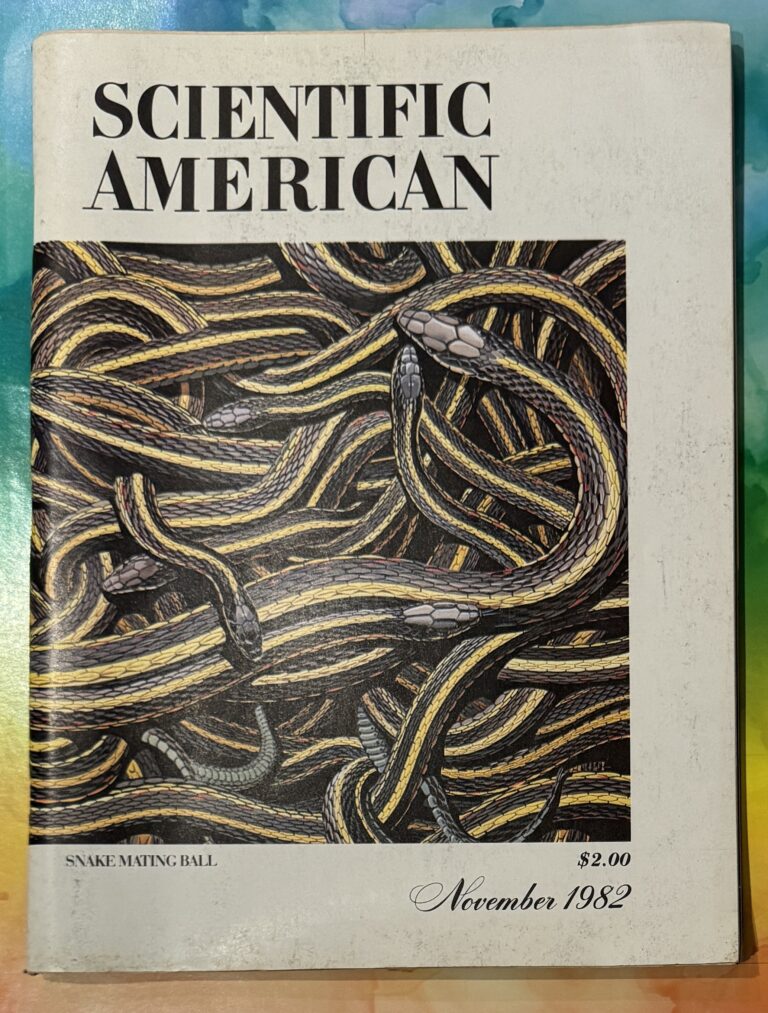
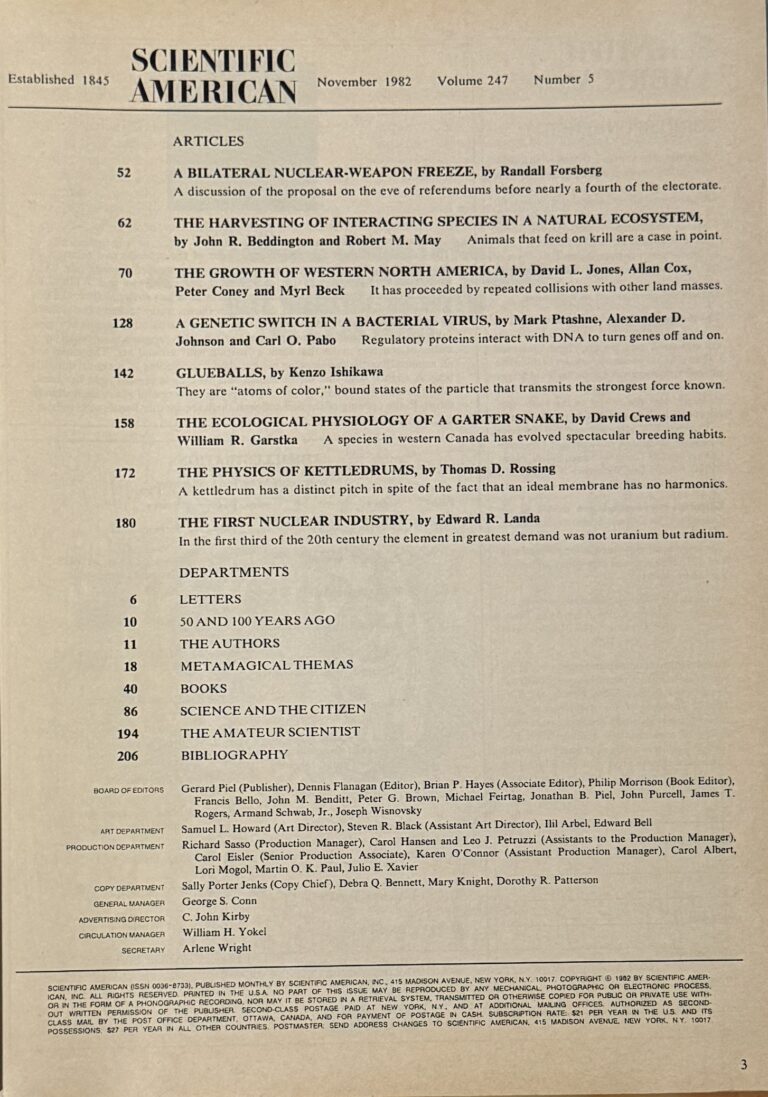
This issue is significant within the preservation collection because it places snake reproductive biology on the cover of a major general science magazine rather than a specialist reptile publication. The cover image is explicitly identified as Snake Mating Ball, while the issue contains the article The Ecological Physiology of a Garter Snake by David Crews and William R. Garstka. Together, the cover and article preserve an example of herpetological research being presented to a broad scientific readership in 1982.
The article concerns the red-sided garter snake of western Canada and explains how the species’ physiology and behavior are synchronized with an extreme seasonal environment. Its breeding aggregations are among the most visually dramatic aspects of that annual cycle, which helps explain the choice of a snake mating ball for the cover.
The issue is also useful for showing how reptile biology appeared within mainstream scientific communication during the period. Rather than presenting snakes primarily through captive care or hobby culture, Scientific American framed the subject through ecology, physiology, reproductive behavior and adaptation. That contrast makes the issue especially useful alongside the specialist reptile magazines preserved elsewhere in the collection.