


United Kingdom
Nature
Publication Identification
| Field | Information |
| Country | United Kingdom |
| Publisher | Macmillan Magazines Ltd. (1998 bibliographic identification) |
| Publisher address | Pending research update. Historical publishing location documented as London, United Kingdom. |
| Magazine title | Nature |
| Publication status | Active; continuing scientific journal |
| Publication run | First published 4 November 1869; continues to present |
| Editor | Pending research update |
| Printer | Pending research update |
| Print ISSN | 0028-0836 |
| Language | English |
| Publication type | International weekly scientific journal |
| Publication frequency | Weekly |
Preservation Significance
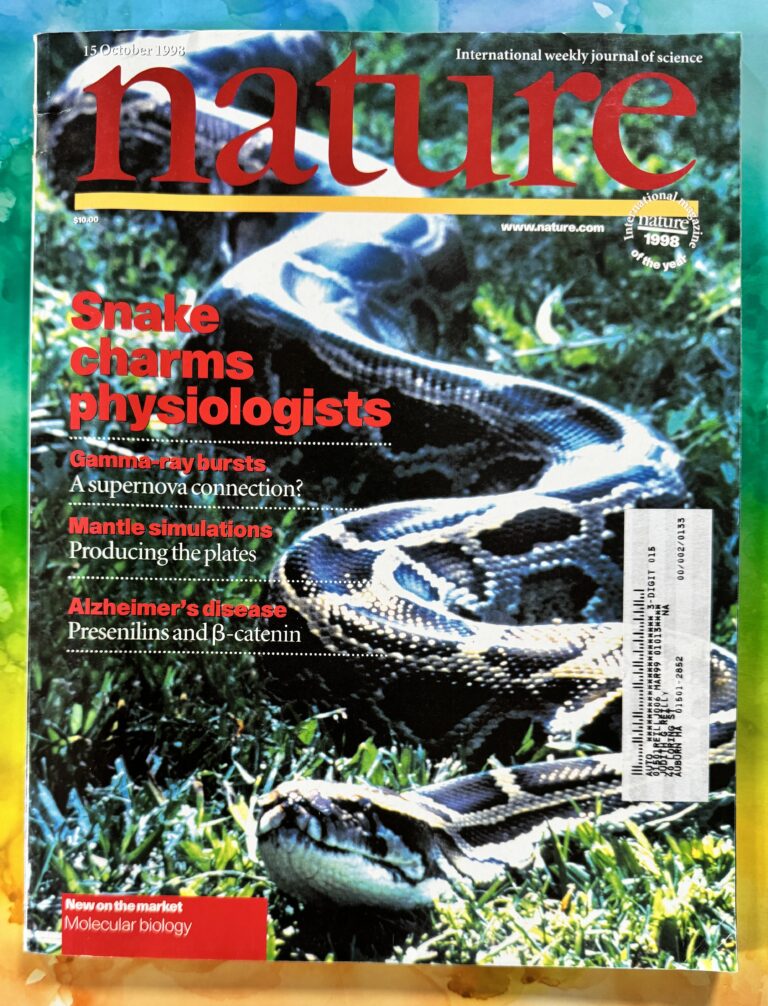
This issue has unusually strong preservation value because the snake material is not a hobbyist feature placed inside a general interest magazine. It is the principal cover subject of one of the world’s major scientific journals. The cover places a large python photograph behind the headline “Snake charms physiologists,” documenting a moment when snake physiology was presented as scientifically important enough to lead an international weekly research journal.
The associated paper by Stephen M. Secor and Jared Diamond examined juvenile pythons as a model of extreme physiological regulation. The authors emphasized the dramatic changes that occur when infrequently feeding snakes process very large meals, including rapid increases in metabolism, secretion, enzyme and transporter activity, and tissue growth. The paper argued that these animals offered an unusually powerful vertebrate model for studying physiological regulation. The article has continued to be cited in later work on python digestion, organ growth and evolutionary physiology.
Within a preservation collection centered on snakes, this issue is particularly useful because it demonstrates the scientific importance of snakes outside the specialist herpetoculture press. It records a point at which python biology was being used to answer broad questions in vertebrate physiology, giving the issue both herpetological and wider scientific historical significance. Unlike fear-oriented popular portrayals, this cover foregrounds snakes as valuable scientific research subjects and emphasizes their importance to broader vertebrate physiology.