


United States
Science
American Association for the Advancement of Science
Publication Identification
| Field | Information |
| Country | United States |
| Publisher | American Association for the Advancement of Science (AAAS) |
| Publisher address | 1200 New York Avenue NW Washington DC 20005 |
| Magazine title | Science |
| Publication status | Active; continuing publication |
| Publication run | 1880 to present |
| Editor | H. Holden Thorp |
| Printer | American Association for the Advancement of Science (AAAS) |
| ISSN | 0036-8075 |
| Language | English |
| Publication type | International weekly scientific journal |
| Publication frequency | Weekly |
Preservation Significance
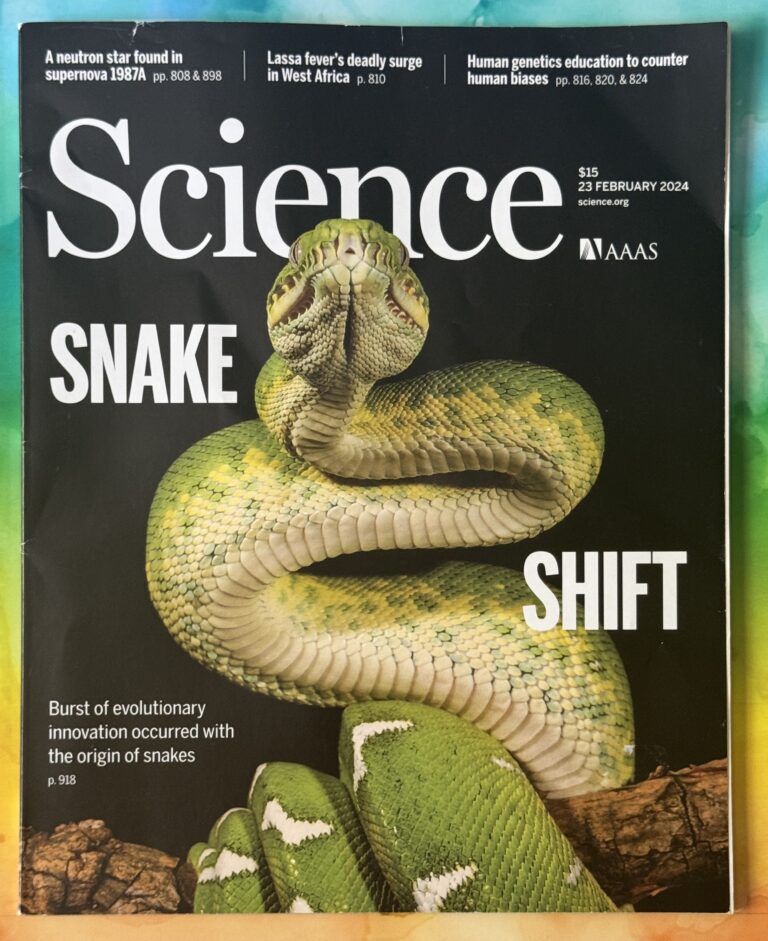
This issue has strong preservation significance because a major general science journal devoted its cover to the evolutionary origin and diversification of snakes. The cover does not treat snakes primarily as captive animals or as unusual wildlife. Instead, it presents snake evolution as a major macroevolutionary event and directs readers to a peer reviewed research article examining why snakes became such an exceptionally successful vertebrate radiation.
The physical issue therefore preserves an example of snake biology appearing at the highest level of mainstream scientific communication. Its significance is strengthened by the direct connection between the cover headline, Snake Shift, and the research article The macroevolutionary singularity of snakes. The article combines genomic, phylogenetic, morphological, ecological and natural history evidence to examine the evolutionary history of snakes and their relationship to other squamates.
Within the preservation collection, this issue also provides a useful contemporary counterpart to older general science magazines that featured snakes. It demonstrates how the scientific questions surrounding snakes have changed over time, from descriptive natural history and physiology toward large scale evolutionary analyses built from genomic datasets, museum material, field observations and comparative methods.